PosteCert breached: 1,561 clients exposed, and the real problem isn't passwords
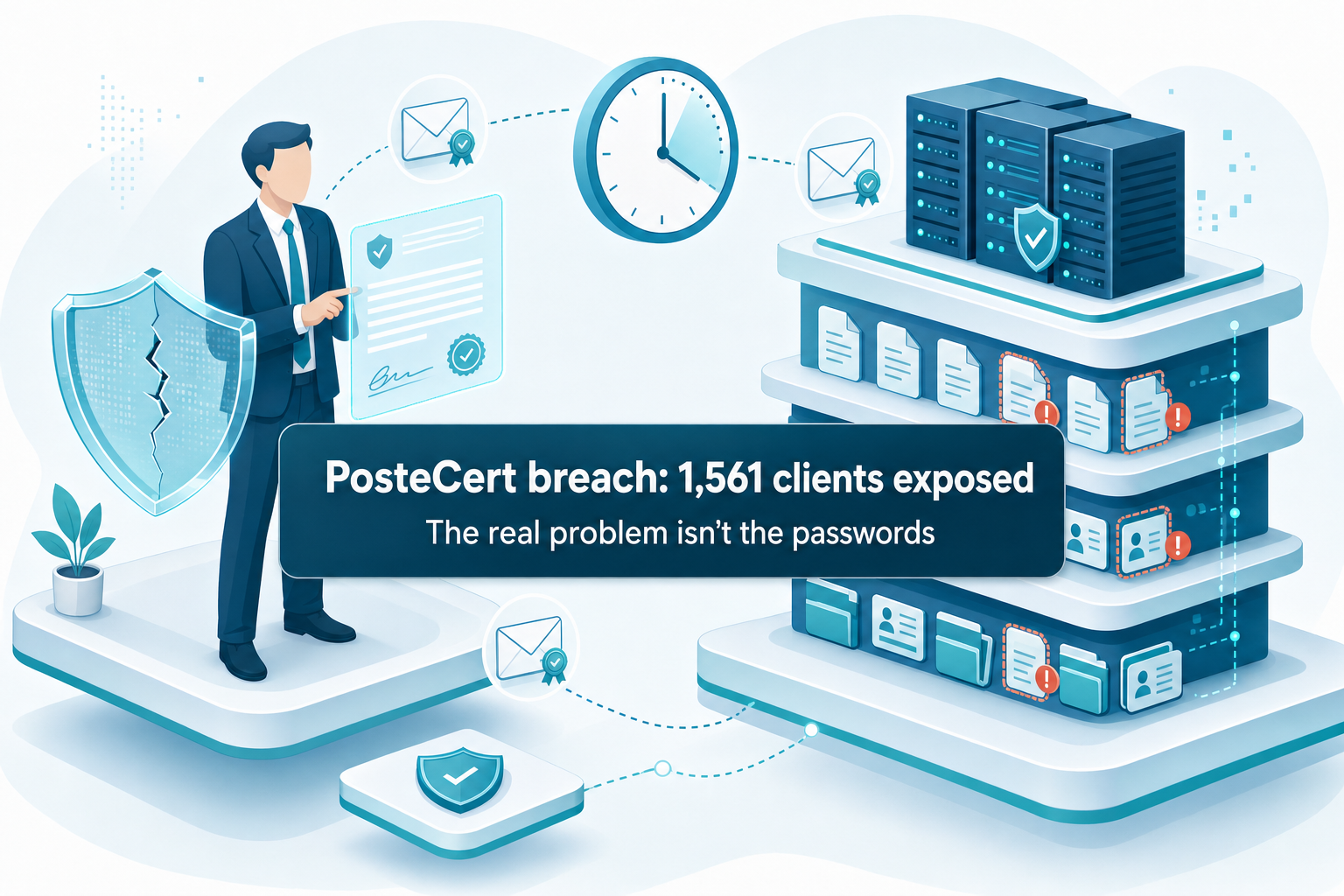
Between 17 and 18 November 2026 an archive of roughly 1 GB of data stolen from PosteCert — Poste Italiane's platform for certified email (PEC) and remote digital signature — surfaced on an underground forum. Poste Italiane confirmed the breach, scoping it down: no credentials, no PosteID/SPID, no payment data. For compliance teams, though, "no passwords were stolen" doesn't close the case: what's exposed here is the personal and contractual data of a qualified trust-service provider, and the material for a credible targeted phishing campaign doesn't need a password.
What happened
The claim
According to several outlets that covered the case, the author goes by the alias "flex22" — a detail that doesn't appear in the Corriere della Sera article (Roberto Cosentino, 19 November 2026) that first analyzed the stolen material, but that several secondary sources report consistently. Corriere writes that the documents had been downloadable for at least three days before publication, with the claim dated between 17 and 18 November: sources differ by one day on exactly when the archive was put up for sale, a minor detail compared to the scope of the data involved.
The (unconfirmed) version of the attack
Contacted by Corriere via Telegram, the alleged author stated he had exploited a vulnerability and a token to access the data, without making ransom demands or threats. It's a self-reported statement, by nature not independently verifiable, and should be treated as such — not as an accepted technical reconstruction.
Poste Italiane, for its part, has not published a dedicated press release: a spokesperson told the press that "checks are underway on the case; a first analysis indicates the breach affects a limited number of people, and the information taken does not concern sensitive data on economic relations with the company" — a quote reproduced identically by several outlets, but it remains a statement made orally to journalists, not a release on the corporate site.
What was taken, and what wasn't
The material concerns 2,158 Remote Digital Signature contracts, traceable to 1,505 people, plus 56 clients with an order but no concluded contract: 1,561 identifiable people in total. The exposed data includes tax code, email, date of birth, residence, phone number, ID card details, and order information (dates, amounts, payment method); in 648 profiles the name of the portfolio advisor also appears.
Excluded, according to the analyzed material and Poste Italiane's position: passwords and login credentials, banking and Postepay data, PosteID and SPID.
At a glance
How the case unfolded
The real risks
No credentials doesn't mean no risk. Name, tax code, contact details and contractual context are exactly the ingredients needed for a credible targeted phishing campaign: a message citing a real contract number or the name of an actual advisor is far harder to recognize as fake than a generic one. The same material lends itself to smishing (SMS), vishing (phone calls) and, in profiles where the advisor's name is exposed, targeted impersonation even toward third parties who were never PosteCert clients themselves.
GDPR obligations and the Garante Privacy
The 72-hour notification window
Art. 33 GDPR requires the data controller to notify the Garante "without undue delay and, where feasible, within 72 hours" of becoming aware of the breach — not from when the breach occurred. It's a distinction that matters: if Poste Italiane knew about the breach before the public confirmation on 19 November, the countdown had already started. At the moment, neither the date the company became aware of it, nor confirmation that the Garante has already been notified, is publicly known.
The precedents
The Garante per la protezione dei dati personali has already sanctioned the Poste group this year: with Provvedimento no. 237 of 17 April 2026, €6,624,000 to Poste Italiane S.p.A. and €5,877,000 to Postepay S.p.A., for processing user data through the ThreatMetrix anti-fraud system in the BancoPosta and Postepay apps. It should be read in the right frame: the measure is under appeal and not final, and counts as a precedent on the Garante's sanctioning posture toward the group — not as a case linked to PosteCert.
No dedicated statement on this case has been published so far, either by the Garante or by the Agenzia per la Cybersicurezza Nazionale (ACN).
What to do if you're an affected PosteCert client
- Verify any communication only through Poste Italiane's official channels, never by replying to links or numbers received via email/SMS.
- Be wary of messages that cite real data (contract number, advisor's name) to appear legitimate: that's exactly the material exposed in this case.
- Watch for any individual notifications from Poste Italiane, and keep any suspicious communication received in the coming weeks.
- If you handle compliance for an organization that is a PosteCert client, assess whether the breach requires an impact assessment for your data subjects.
Why it matters to compliance teams even if you're not a Poste client
PosteCert isn't just any supplier: it's a qualified trust service provider (QTSP) for PEC and digital signature, a link in the data-processing chain that many organizations rely on without treating it as a "critical vendor". This case is a concrete reminder: due diligence on QTSPs should be handled like due diligence on any other vendor that processes personal data on your behalf, not as a technical detail delegated by default.
Conclusion
The PosteCert breach isn't just another hacker story: it's a textbook case of what happens when the breach hits the trust-service provider, not the client organization. No passwords stolen, but 1,561 people with personal records and contracts exposed, a notification deadline running from a date that hasn't been disclosed, and a supervisory authority that — on this specific case — hasn't yet spoken. For compliance teams, the question isn't whether it concerns Poste Italiane, but whether it concerns your own chain of trust-service providers.
Sources
- Corriere.it — "Attacco hacker a Poste Italiane: violata la piattaforma per la mail certificata PosteCert", Roberto Cosentino, 19 November 2026.
- Punto Informatico — "Poste Italiane conferma violazione piattaforma PosteCert".
- Cybersecurity360 — "Furto dati a Poste Italiane: l'esposizione di nomi e mail aumenta il rischio phishing e frodi".
- Garante per la protezione dei dati personali — institutional data breach page (Art. 33 GDPR, 72 hours).
- Garante per la protezione dei dati personali — Provvedimento of 17 April 2026 [10241537].
Do you know who processes your clients' data on your behalf?
We map your vendors — certified email, digital signature and other trust services included — check contracts and safeguards, and set up your data-breach procedure before you need it. Let's talk.
Let's talk about your vendors →