When the Vendor Is the Weak Link: What the Optimizely Breach Teaches About Supply-Chain Governance
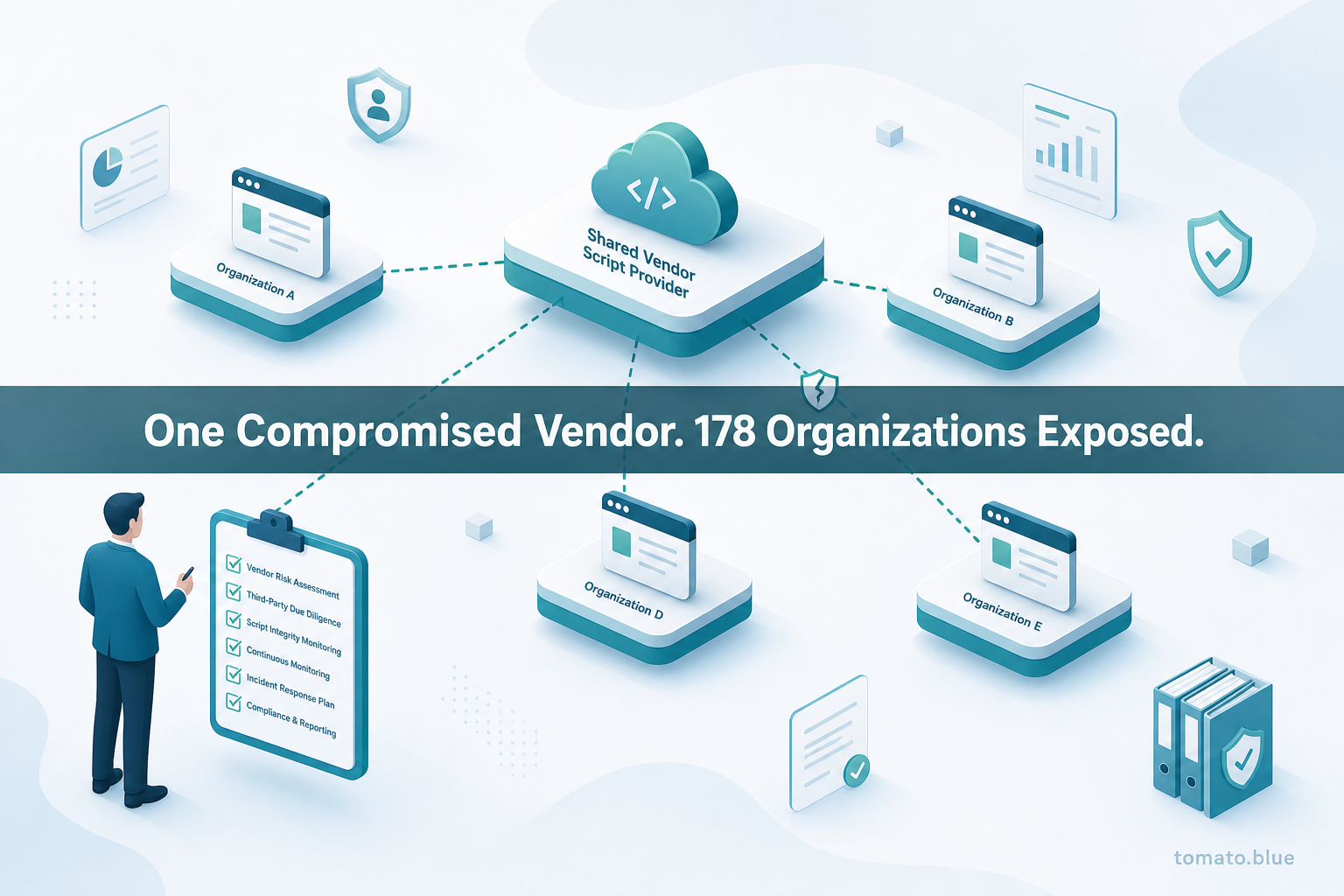
One compromised vendor — an A/B testing platform, not a mission-critical system — and 178 organizations, including global banks, ended up serving code that stole payment cards, cookies and screenshots. Not a flaw in their own systems: a third-party script nobody was watching closely anymore.
What happened
Between 16 and 17 November 2026, it emerged that web experimentation platform Optimizely had distributed compromised JavaScript, through its own CDN, to at least 178 client organizations. The research that uncovered the case was published by Report URI (Scott Helme) and confirmed, with identical figures, by SecurityWeek, Cybernews and Security Affairs: 188 infected scripts out of 1,611 examined.
The mechanism
The malicious code wasn't injected into the affected companies' own sites, but into the shared platform those sites load to run A/B tests. According to Optimizely, the root cause was a vulnerability in the Web Experimentation account signup flow, exploited by an unauthorized party: "the vulnerable path is blocked, the injected code was removed, and customers have been contacted directly," the company stated. The payload skimmed payment card data, swapped cryptocurrency wallet addresses, captured cookies and screenshots, and delivered an additional exploit on iOS/iPadOS devices.
Who was involved
Among the 178 affected brands, at least seven have been confirmed by sources independent of the post that first disclosed the case: Zoom, BBC, CNN, Salesforce, IKEA, HSBC and Ledger. Finance is the most exposed sector by count — 32 banking or insurance organizations — with HSBC present across 11 separate markets, including the US, Hong Kong, Singapore and the UAE.
Why this is a supply-chain problem, not a "website security" problem
The difference between breaching a company and breaching its vendor
None of the 178 organizations suffered an intrusion into their own internal systems. What was breached was a vendor they all shared. That's the difference between a data breach and a Magecart-style supply-chain attack: there is only one real target, but the impact multiplies across every customer that trusted that vendor without re-checking it over time.
Why third-party scripts effectively have full access to the page
In the browser, a script loaded from a third party runs with the same privileges as the hosting site's own code: it can read the DOM, intercept forms, modify content, and access cookies and local storage. By design, the web has no automatic "sandbox" for third-party scripts — trust is implicit the moment you load one.
The paradox of security spending
Millions on the internal perimeter, zero visibility on external dependencies
One detail sharpens the point: some of the organizations involved, HSBC among them, had a Content Security Policy (CSP) in place — one of the technical controls most often cited to limit exactly this kind of risk. They were still partially exposed because the payload exploited the unsafe-eval setting, which Optimizely's own documentation asks customers to enable for the platform to work. The control existed; the vendor's own recommendation neutralized it.
Why the problem doesn't close by "patching" the vendor
Optimizely fixed the vulnerability and removed the injected code, but the governance issue remains: a company can't "patch" the trust it placed in a vendor — it can only revise the process by which it grants that access. On this point, Tomato colleague Francesco Cabras offered a counterpoint worth quoting, as an opinion rather than a finding: "it turned out that rebuilding everything with vibe coding is actually less problematic, because the attack surface and the vendor chain end up shorter…" It's a suggestive thesis, but one to qualify carefully: AI-generated code doesn't eliminate third-party dependencies — it still relies on external libraries, runtimes and cloud services — and it brings risks of its own (unverified quality, no audit trail, systematic model errors). A shorter chain isn't automatically a safer one, and it shouldn't be read as this case's conclusion, only as a lead worth checking on its own merits.
What this means for corporate governance
Inventory and control of third-party scripts
The first operational question isn't "are my systems secure" but "do I know exactly which third-party scripts run on my site and what they can do." An up-to-date inventory, Subresource Integrity (SRI) where applicable, and a CSP that does more than exist on paper are the starting point — with the added awareness, after this case, that even a well-written CSP can be bypassed by a setting the vendor itself asked you to enable.
Contractual accountability and martech/SaaS due diligence
Vendor assessment can't end at onboarding. Contract clauses on incident notification, response times and liability need to be negotiated before integrating a business-critical script, not after an incident.
Continuous monitoring vs. one-time trust
A vendor approved a year ago isn't automatically a safe vendor today. Monitoring third-party scripts should be a continuous process — change detection on loaded scripts, periodic review of granted permissions — not a box checked once.
Operational take-aways
- Your security perimeter includes any vendor executing code on your site, not just internal systems.
- Repeat vendor assessment over time, not only at onboarding.
- Govern CSP and SRI as an ongoing process, not a one-off task.
- Check whether vendor-required settings (e.g.
unsafe-eval) undermine your own controls. - The right question isn't "am I secure," but "which third-party scripts run, and what can they actually do."
Do you know which third-party scripts run on your site?
We map scripts, vendors and CSP, and turn vendor assessment into a continuous process instead of a box ticked at onboarding. Let's talk.
Let's talk about your third-party vendors →