NIS2 in Italy: What SMEs and Suppliers Must Do by October 31, 2026
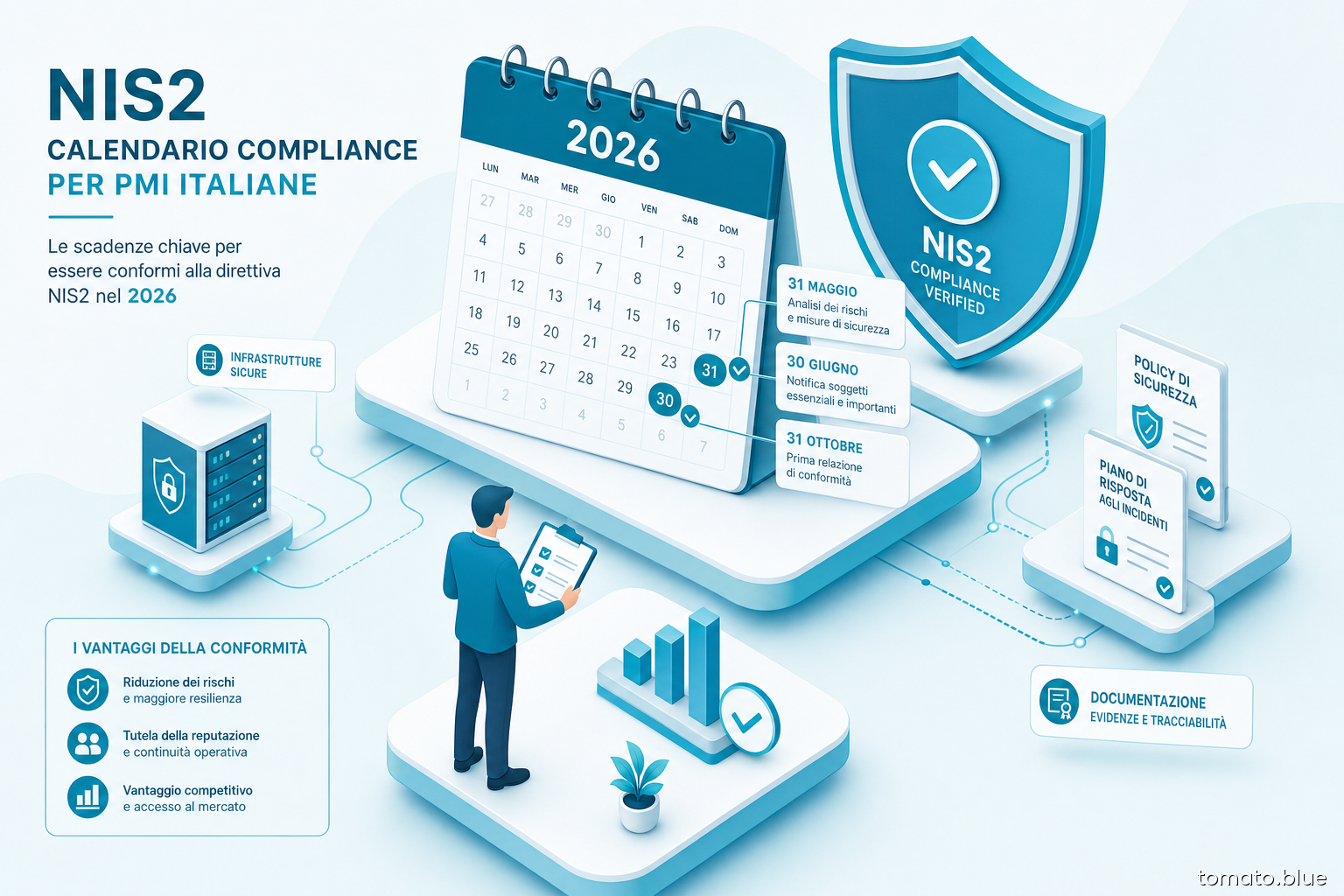
The 2026 calendar is set. Three dates really matter: May 31, June 30, October 31. The first is only weeks away.
Article 4 of ACN Determination No. 379907/2025 sets October 31, 2026 as the ultimate deadline by which first-wave entities must have all baseline security measures operational, with documentary evidence. This is not a declarative deadline: ACN requires verifiable proof of compliance.
For Italian SMEs that were registered in 2025 — or that will register during May-June 2026 — the countdown starts now. Five net months to close the 37 (important) or 43 (essential) minimum controls.
What changed with Determination 379907/2025
Italian Legislative Decree No. 138 of September 4, 2024 transposed European NIS2 (Official Gazette No. 230 of October 1, 2024, in force since October 16, 2024). The decree delegated the technical regulation of concrete security measures to ACN. That regulation has arrived: Determination 379907/2025 from the ACN Director General, applicable from January 15, 2026.
The Determination articulates two levels of obligations:
- Important entities: 37 security measures, articulated in 87 operational requirements (Annex 1)
- Essential entities: 43 measures, 116 requirements (Annex 2)
The difference is not cosmetic. The 6 additional measures for essential entities cover areas like advanced business continuity, vulnerability management with tight timelines, and active supply chain supervision. Knowing which category your organization falls into is the first step: criteria are set by D.Lgs. 138/2024 (sectors, size, role as essential or important service for the national system).
The 2026 operational calendar
Three closely-spaced deadlines, each with a distinct obligation:
May 1 – June 30, 2026 · Annual window for communicating activities and services to ACN
This is the period established by Article 30 paragraph 1 of D.Lgs. 138/2024 to update the list of activities and services on the ACN platform. It is not an audit: it is a self-declaration, but with substantial effects on categorization and therefore on applicable obligations.
May 31, 2026 · Communication of relevant NIS suppliers
By this date, subject organizations must transmit to ACN the list of suppliers relevant for NIS2 purposes. This is the first step to activate supply chain risk management obligations — the area on which, as written in a previous blog article, "those not ready exit the market".
October 31, 2026 · Full compliance with baseline security measures
The decisive deadline. For the first wave of entities — those already registered from 2025 — all 37/87 or 43/116 measures must be operational with demonstrable documentary evidence. This is not about policies written and unimplemented: ACN can verify actual application.
What to do now
For those who haven't yet set up an operational plan, five months are few but sufficient if you start from the few points that generate the greatest impact.
- Map your regulatory position. Essential or important entity? Which services apply? Which suppliers are "relevant" for NIS2 purposes? This mapping must be completed before the ACN window of May 1, to avoid communicating categorizations that don't hold up under verification.
- Compare current posture with Annex 1 or 2 of the Determination. A serious gap assessment — not a questionnaire — is the fastest way to understand where interventions are needed before October 31. Measures not met must be mapped to concrete initiatives with internal deadlines well before September 30, to have a month of margin.
- Start due diligence on critical suppliers. The supply chain risk management obligation enters into force in the 2026 calendar with the May 31 communication. Starting contractual and technical assessments of the most strategic IT/cloud suppliers is the priority for June.
- Document demonstrably. ACN doesn't just ask "done" — it asks for evidence. Procedures, registers, execution logs, incident simulation reports: everything must be versioned and archived so that an external verifier can reconstruct compliance. For those who already have an ISO/IEC 27001 ISMS in place, much of the work is mapping NIS2 controls to already-implemented ISO controls.
- Plan for post-October 31. Compliance is not an event, it's a regime. The first realignment on the ACN platform will need to be redone in the May 1 – June 30, 2027 window. Building an annual operational cycle from the start avoids chasing every deadline.
What to do on your systems: practical examples
The measures in Annexes 1 and 2 of ACN Determination No. 379907/2025 translate, on the technical level, into concrete interventions on software, configurations, and processes. Some practical examples of what an organization must put in place:
- Install packages and software. Deployment of log monitoring solutions (SIEM), EDR/XDR agents on endpoints, and data encryption tools, consistent with the monitoring and protection requirements of ACN Determination No. 379907/2025.
- Change configurations. Mandatory activation of multi-factor authentication (MFA) on all privileged access — the minimum requirement set by ACN — with extension to all users as a recommended best practice; segmentation of corporate networks and server hardening.
- Update code and applications. Remediation of known vulnerabilities in proprietary software and configuration of secure APIs for data exchange.
- Review access management. Application of the principle of least privilege, disabling obsolete accounts and limiting administrator permissions.
- Business continuity systems. Technical configuration of immutable and redundant backups, with periodic automated restore tests, in line with the continuity requirements of ACN Determination No. 379907/2025.
The sanctions that remind us what's at stake
D.Lgs. 138/2024 sets sanctions for essential entities up to €10 million or 2% of annual worldwide turnover, and for important entities up to €7 million or 1.4% of turnover. Minor violations — communication delays, documentary omissions — stand at 0.1% (essential) and 0.07% (important). Numbers that aren't reached for a single missing control, but that exist because substantive compliance is mandatory.
For an SME with €5-20M turnover, even 0.07% translates into €3,500-14,000 per violation, a figure that adds to the reputational and contractual cost of public exposure. For essential entities, the same proportion of 0.1% raises the threshold to €5,000-20,000 per episode.
Sources
- D.Lgs. September 4, 2024, No. 138 — Official Gazette
- ACN Determination No. 379907/2025, Annexes 1 and 2 (security measures for important and essential entities)
- ICT Security Magazine — NIS2 obligations: complete roadmap to October 2026
- Fasolaw — NIS2 2026 deadlines and new obligations by June