Legitimate Interest: The EDPB's Guidelines 1/2024 in Their Final Version
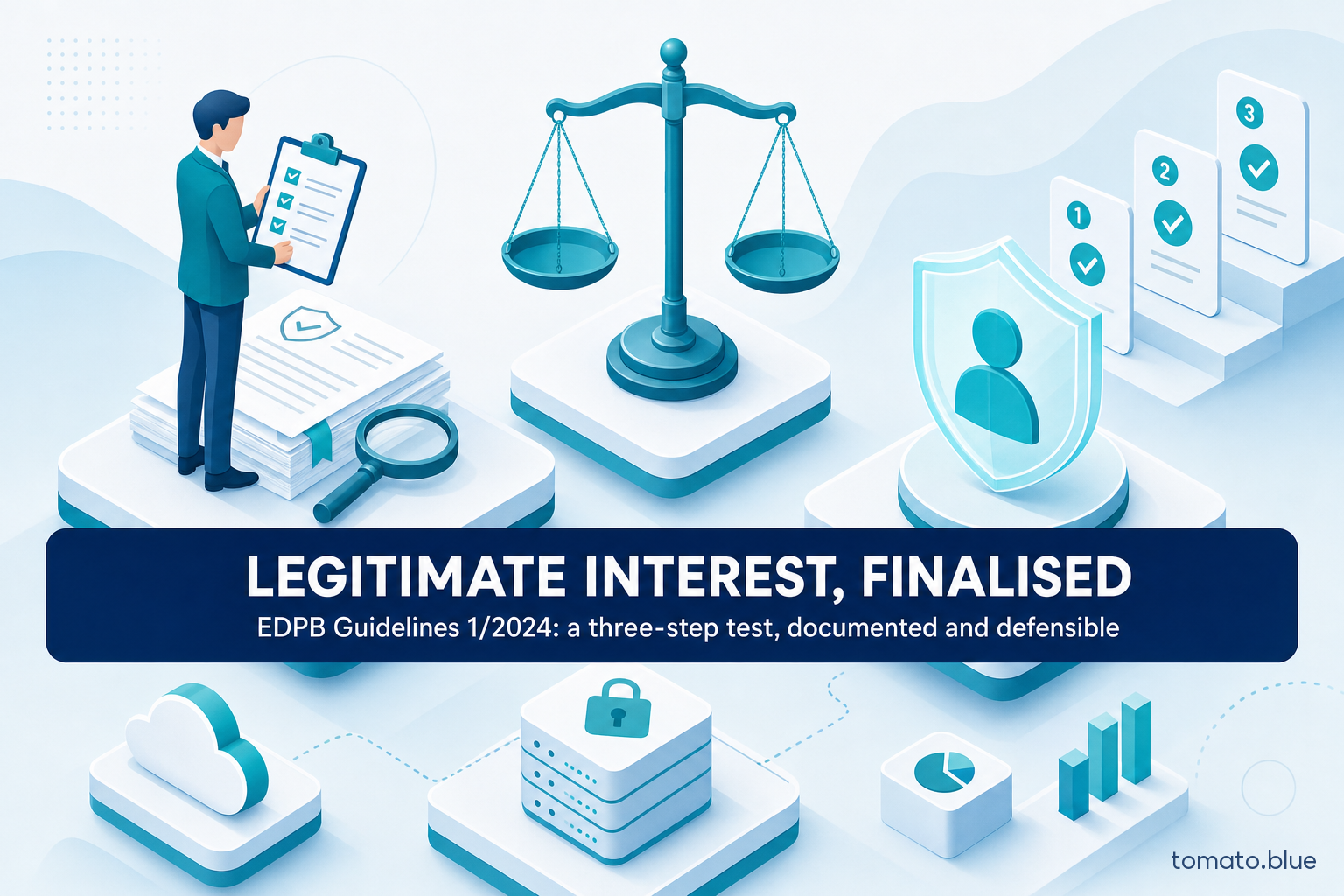
On 10 November 2026, two years after the version put out for consultation, the EDPB adopted the text that gathers and updates the legacy of the 2014 WP217 opinion. Legitimate interest comes out confirmed as a fully-fledged legal basis, but at a precise entry cost: a three-step assessment, carried out in advance, documented and defensible.
In Summary
- Three cumulative conditions: legitimate interest, necessity, balancing. Missing one, and the legal basis collapses.
- Before, not after: the assessment precedes the processing, must be carried out for each purpose and documented. The burden of proof lies with the controller.
- Lawful, clear, present interest: generic formulas and future or hypothetical interests fail the first step.
- Necessary is not the same as useful: if a less invasive, equally effective means exists, the test fails.
- The privacy notice does not create reasonable expectations, and neither does industry practice.
- The interest must be stated at the time of collection: without this information, point (f) does not hold.
- Objection raises the bar: continuing requires compelling grounds, not just confirming the initial test.
- Marketing: where ePrivacy requires consent, point (f) is precluded. Invasive profiling and tracking rarely pass the balancing test.
- Children: in case of conflict, their interest generally prevails.
Neither Last Resort Nor Open Door
On 10 November 2026 the EDPB adopted version 2.0 of Guidelines 1/2024 on processing based on Article 6(1)(f) GDPR. The text closes the process launched on 8 October 2024 with version 1.0, put out for public consultation.
The document is substantively built on Opinion 06/2014 of the Article 29 Working Party (WP217), issued under Directive 95/46/EC. It updates that opinion to the GDPR and to twelve years of Court of Justice case law: Rīgas satiksme, Meta v. Bundeskartellamt, SCHUFA, KNLTB, Mousse, up to the recent NTH Haustechnik of 18 June 2026.
The underlying position rests on two negatives (para. 9). Legitimate interest is not a residual legal basis, to be used only when the others do not work. Nor is it the “convenient” basis, to be chosen because it is perceived as less binding than consent. Among the six bases of Article 6 there is no hierarchy, but all bases other than consent must be interpreted restrictively.
From this follows the operating rule underpinning the entire document: the assessment must be carried out before the processing begins, for each purpose, and must be documented. The burden of proof lies with the controller. Where a DPO is appointed, they must be involved promptly (para. 12).
The Three-Step Test
The three conditions are cumulative and must be verified in sequence: if even one is missing, point (f) cannot be used. Identifying a legitimate interest, on its own, is never enough (para. 11).
| Step | Question | When the test fails |
|---|---|---|
| 1. Interest | Is the interest lawful, clearly articulated, present and concrete? | Interest contrary to law, vague, or merely hypothetical |
| 2. Necessity | Can the same result be achieved by less invasive and equally effective means? | The processing is useful but not strictly necessary |
| 3. Balancing | Do the interests, rights and freedoms of the data subject prevail? | Disproportionate impact, not reducible through further measures |
Step 1: A Lawful, Clear, Present Interest
The EDPB first distinguishes between interest and purpose (para. 13). The purpose is the specific reason for the processing. The interest is the broader benefit the controller derives from it: promoting one's own products is an interest, direct marketing is the purpose that serves it.
There is no closed list of legitimate interests, and even a purely commercial interest can qualify (KNLTB). However, three cumulative requirements apply (para. 16):
- Lawfulness. The interest must not conflict with EU or national law. Example 1: the promotional emails of an e-cigarette seller are not based on a legitimate interest, because that advertising is prohibited by the Tobacco Products Directive.
- Clarity. The scope must be precisely defined. Example 2: neighbourhood video surveillance “for the good of the community” is too generic to be assessed.
- Present existence. The interest must exist at the time of the processing. Example 3: a newspaper that keeps former subscribers' data for a magazine it has not yet decided to launch is pursuing a merely hypothetical interest.
On lawfulness, a clarification drawn from NTH Haustechnik (footnote 30) carries weight: anyone who receives data knowing, or who should know, that it was unlawfully collected or retained by the party transmitting it cannot invoke legitimate interest. For those purchasing lists, datasets or models from third parties, due diligence on provenance becomes a condition of lawfulness.
The interest may also belong to an identified third party: example 4 is the taxi company that discloses the passenger's identity to the owner of the damaged scooter. It must not, however, be confused with the general interest of the community, which belongs to points (c) and (e). For a commercial operator, collecting data to prevent crime is not, as a rule, its own interest (para. 19).
Finally, weight matters (para. 18). A marginal interest justifies only insignificant impacts. The more significant the interest, the greater the impact it can bear, with the appropriate safeguards.
Step 2: Necessary Does Not Mean Useful
Necessity is an autonomous concept of EU law and must be read together with the minimisation principle. The Court speaks of processing that is “strictly necessary”. If a reasonable, equally effective and less invasive alternative exists, the test fails (para. 26).
When the interest belongs to a third party, demonstrating this is harder, and the processing is less foreseeable for the data subject (para. 27).
Step 3: The Balancing Test
The goal is not to eliminate every impact, but to avoid a disproportionate one (para. 30). The controller must identify and describe four elements.
Interests and rights of the data subject.Not only privacy and data protection: also freedom of expression, non-discrimination, property, physical and psychological integrity. Simple economic, social and personal “interests” count too.
Impact of the processing. It depends on three factors:
- nature of the data: special categories, criminal data, data perceived as more private (financial, location). A dataset where even a single Article 9 data point was collected in bulk is treated in its entirety as a special category, and what matters is what can objectively be inferred from the data, not the controller's intention;
- context: scale, combination with other datasets, the controller's position (an employment relationship is not the same as a relationship with a customer), vulnerability of data subjects. The fact that data is public does not in itself authorise the processing;
- consequences: legal effects, exclusion or discrimination, reputational damage, economic losses, up to the feeling of loss of control and the chilling effect of continuous monitoring.
One point deserves emphasis (para. 45): the impact being weighed is the one already minimised by the measures the GDPR requires in any case, starting with Articles 5 and 25. Privacy by design is the starting point, not a merit to claim credit for in the balancing test.
Reasonable expectations. These are assessed at the time of collection and from the standpoint of the average data subject. Two caveats dismantle common practices:
- what is industry practice is not, for that reason alone, expected by the data subject (para. 49);
- the privacy notice does not create reasonable expectations: complying with Articles 12-14 is not enough (para. 50).
The examples are clear-cut. A user of a free social network does not expect personalised advertising without consent, nor the use of their data to improve the product (example 5). Someone who posts their own photo online does not expect to find it on a flyer (example 6).
Closing the balancing test and mitigating measures. If the balance tips towards the data subject, the controller may introduce measures that go beyond its legal obligations (paras. 53-54):
- enhanced transparency, beyond Articles 13 and 14: FAQs, graphic visualisations, voluntary annual reports;
- an unconditional opt-out offered before the processing begins;
- erasure granted even outside the cases listed in Article 17;
- a reasonable interval between collection and use of the data, to allow the exercise of rights.
The list is illustrative. Those who adopt these measures must demonstrate how they change the outcome of the test (para. 56). If the balance still cannot be achieved, point (f) cannot be used (para. 58).
Legitimate Interest and Data Subjects' Rights
Choosing point (f) means accepting a stricter regime of rights than under the other legal bases. Chapter 3 reconstructs this right by right.
Transparency. The privacy notice must state that the processing is based on Article 6(1)(f) and which specific interest is being pursued. This is not a formality: according to Mousse (footnote 94), if the interest is not communicated at the time of collection, that collection cannot be justified by legitimate interest. As good practice, the EDPB suggests a layered notice anticipating the elements of the balancing test, and in any case informing data subjects that the test is available on request (para. 66).
Access. Article 15 does not require stating the legal basis, but the EDPB recommends doing so: without knowing it, the data subject cannot know which rights to exercise (para. 68).
Objection. This is the most delicate point. The balancing under Article 21(1) differs from that under Article 6 (para. 72):
- it is not enough to show that the initial assessment was correct;
- compelling legitimate grounds are required, a higher threshold than mere legitimate interest. Examples: protecting the organisation from serious and imminent harm, or from a severe penalty. A mere advantage for the controller is not enough;
- the assessment is individual, referring to the particular situation of the person objecting, and must be documented;
- a poorly reasoned objection cannot be rejected on that ground alone: the controller may ask for clarification (para. 70).
The burden of proof lies with the controller, and the presumption favours the data subject. While the verification is pending, the data subject can obtain a restriction of processing (Article 18).
Erasure. If the objection is upheld, as a rule the related erasure request must be upheld too (para. 76). Faced with an ambiguous request, the controller cannot simply treat it as an objection: it must determine whether the data subject wants erasure and, when in doubt, ask (para. 77).
Automated decisions and profiling. Article 6(1)(f) is not, in itself, a provision that authorises automated decisions within the meaning of Article 22(2)(b). Where profiling is involved, the balancing test must weigh the level of detail of the profile, its completeness, the impact, the possible future combination of profiles, and safeguards for fairness, non-discrimination and accuracy (para. 81).
Rectification. This is especially relevant when data is not collected directly from the data subject, a frequent scenario under point (f), because inaccuracy is more likely (para. 83).
Application Contexts
Chapter 4 applies the test to the cases the GDPR itself references in recitals 47-50. The common message: being mentioned in a recital is not equivalent to a green light, and the test must always be carried out in full.
| Context | EDPB's Position | Watch Out For |
|---|---|---|
| Children | The balancing test must be recalibrated: in case of conflict, the child's interest generally prevails | Profiling for marketing and targeted advertising purposes: generally incompatible |
| Public authorities | Point (f) excluded for institutional tasks | Admitted only in exceptional cases, for activities unrelated to those tasks, to be documented |
| Fraud prevention | Legitimate interest where the processing is strictly necessary | “Fraud prevention” in a privacy notice is too generic |
| Direct marketing | Possible only where the law does not require consent | Invasive profiling and tracking: a positive outcome is highly unlikely |
| Corporate groups | Intra-group transfers for internal administrative purposes are admissible | Employee data and national rules under Article 88 |
| Network and information security | Point (f) usable in principle | Security does not justify excessive processing |
| Communications to authorities | Occasional reports of possible crimes are admitted | Preventive and systematic collection: not the interest of a commercial operator |
Children
Point (f) can be used when the controller's interest coincides with that of the child. In case of conflict, especially where the interest is commercial, the child generally prevails (para. 95). The controller must demonstrate that it has treated the best interests of the child as a primary consideration, calibrating the assessment by age group (paras. 96-97). The DSA already prohibits online platforms from advertising based on profiling of minors.
Fraud Prevention
Anti-fraud controls also affect those with no fraudulent intent whatsoever, and this weighs in the balancing test (para. 100). The controller must state which fraud it intends to prevent and which data is genuinely needed. The severity of the fraud increases the weight of the interest. Where controls are required by law, the correct basis is point (c) (para. 106).
Direct Marketing
The approach has two steps.
- Check whether the law precludes point (f). For emails, SMS, messaging and similar channels, the ePrivacy Directive requires prior consent. The same applies to cookies and tracking techniques: consent will, as a rule, also be the basis for subsequent processing (para. 114).
- Only where there is no such preclusion, carry out the test case by case. A catalogue sent to all customers who have already bought similar products is easier to justify. Tracking across different sites, devices and services is rarely so (para. 119).
On soft spam, the final version incorporates Inteligo Media (13 November 2025): when the conditions of Article 13(2) ePrivacy are met, that provision alone suffices for the sending, and there is no need to identify a basis under Article 6 GDPR (para. 115). For reference, the Italian implementing provision is Article 130(4) of the Privacy Code.
The concept of direct marketing is not limited to commercial purposes: it also covers unsolicited communications from political parties, associations and charities (para. 109). The objection under Article 21(2) remains unconditional: no justification, no balancing test.
Corporate Groups
Recital 48 helps with the first step of the test, not with the other two. Transferring data from a subsidiary's CRM to the central one for reporting or IT security purposes can be based on point (f), if necessity and balancing hold up (para. 122). For employees, national rules under Article 88 must be considered, which may shift the basis to point (b) or (c). Informing employees about intra-group data flows is required in any case.
Network and Information Security
The basis is recognised by recital 49 and by recital 121 of the NIS2 Directive. The limit is proportionality: deep packet inspection and invasive analysis of content and metadata significantly affect the balancing test (para. 126). Where the security measure is required by a legal provision, the basis may be point (c).
Communications to Authorities
Recital 50 covers the reporting of specific cases, not generalised and preventive collection. Example 8 is topical: after a cyberattack, the controller notifies the breach to the Italian Data Protection Authority (Garante) on the basis of point (c). It may then share IP addresses and identifiers of the attackers with the competent cybercrime and cybersecurity authorities on the basis of point (f), if the disclosure is not already mandatory.
For requests from third-country authorities, avoiding foreign sanctions can be a legitimate interest. The EDPB notes, however, that it has already found the rights of data subjects to prevail in the Cloud Act case, and that Chapter V on transfers still has to be respected (paras. 135-136).
And Artificial Intelligence
The Guidelines do not devote a chapter to AI, but refer to Opinion 28/2024 on AI models and to Guidelines 03/2026 on web scraping (para. 90). Developing a conversational agent, a fraud detection system or a threat detection system can constitute a legitimate interest. Necessity and balancing must then be carried out using the specific criteria of those documents.
What to Do Now
The Guidelines do not introduce new obligations, but they set the standard by which authorities will read existing assessments. Those with LIAs written on the 2014 model, or with none at all, have work to do.
☐ Map in the register all processing activities based on point (f), purpose by purpose
☐ Rewrite generic interests (“service improvement”, “security”, “fraud prevention”) in specific, present terms
☐ Check legal preclusions: ePrivacy and Article 130 of the Privacy Code for marketing, employment rules for employee data, obligations that shift the basis to point (c)
☐ Document the less invasive alternatives considered and why they were discarded
☐ Redo the balancing test, separating measures required by law from additional ones, explaining how the latter change the outcome
☐ Update privacy notices: legal basis, specific interest pursued, availability of the test on request
☐ Review the rights procedure: individual assessment of objections using the compelling-grounds criterion, restriction pending verification, resulting erasure, handling of ambiguous requests
☐ Check the provenance of data, lists and datasets received from third parties
☐ Involve the DPO and assess the DPIA where risk is high
☐ Set a periodic review: an interest that is present today may not be so in a year
The Tomato Blue Take
The Guidelines treat legitimate interest as a design decision, not as a clause to insert into a privacy notice. That is the point that convinces us most.
Paragraph 45 says it without mincing words: privacy by design is the starting point of the balancing test. A badly designed system cannot be saved by a well-written LIA. A well-designed system, with genuine minimisation, native opt-out and codified retention periods, arrives at the test with half the work already done.
This is why the LIA cannot remain a static document in a folder. It must live where the processing lives: in the register, in product requirements, in the procedures that handle objections and erasure requests. And it must interact with the other safeguards. Network security points to NIS2, model training to Opinion 28/2024 and the AI Act, reports to authorities to incident-notification obligations.
Compliance as architecture is exactly this: a single assessment, built properly once, that holds up in front of the data subject, the supervisory authority, and the client running due diligence.
Source
- EDPB, Guidelines 1/2024 on processing of personal data based on Article 6(1)(f) GDPR, version 2.0, adopted on 10 November 2026 (version 1.0 for public consultation: 8 October 2024). References to paragraphs, examples and footnotes refer to this text.
Do your LIAs hold up to the three-step test?
We review your legitimate interest assessments, purpose by purpose: specific interest, discarded alternatives, documented balancing and rights procedures. Let's talk.
Let's talk about your LIAs →