ISO 9001:2026 Has Been Published for Weeks: What Actually Changes for Measuring Equipment
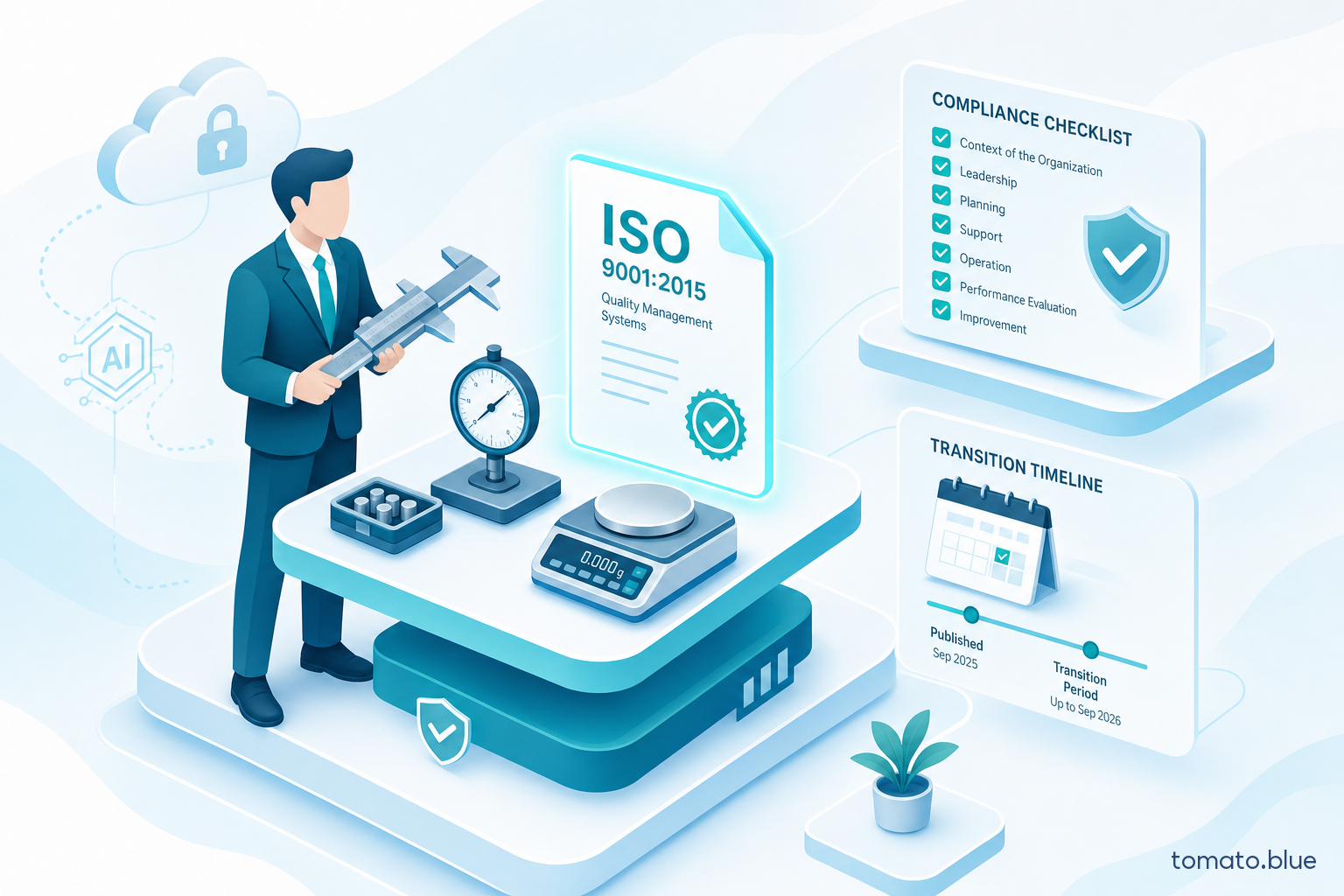
UNITRAIN, the Italian training arm of UNI, has opened registrations for a course on 26 November about managing measuring equipment "according to the new UNI EN ISO 9001". The title might suggest an anticipation, or a marketing inference, of an unreleased standard — but the standard it refers to has in fact been public for nearly two months: UNI EN ISO 9001:2026 was released on 16 September 2026, confirmed by a primary ISO source and by UNI. The editorial question, then, is not whether the standard exists, but what actually changes — and how much, for anyone managing calibration and measuring instruments — compared with what the course title implies.
The UNITRAIN Course: What It Offers and to Whom
The UNI page announcing the course sets it for 26 November and frames it explicitly "in accordance with the UNI EN ISO 9001:2026 standard" — not a detail buried in the announcement text, but the title of the course itself as sold on UNIstore. The stated content remains generic — metrological confirmation, calibration, traceability — without anticipating which specific clauses of the standard have actually changed. The natural audience overlaps with this article's: quality and metrology managers, internal auditors, consultants running integrated management systems.
The Standard Is Published: Dates and Sources
The primary source is the ISO/TC 176/SC 2 technical committee page, which on 28 September 2026 announced the release of ISO 9001:2026 (sixth edition) with a publication date of 16 September 2026. On the Italian side, UNI made the standard available in Italian and English the same day, as reported in its own announcement and on the UNIstore sales landing page, including "redline" versions with changes highlighted. Both facts are confirmed by a primary source and cross-checked against several independent secondary sources, all converging on the same date — a level of confirmation the original brief for this piece, based solely on a course title, did not yet have.
Transition Deadlines Worth Putting on the Calendar
The same ISO/TC 176/SC 2 announcement sets out the transition timeline: accreditation bodies must be ready to accredit against the new edition by 31 March 2027; certification bodies must declare their own transition by 30 June 2027, with accreditation decisions due by 30 September 2027. From 31 March 2028, new certifications can only be issued against the 2026 edition; organizations already certified have until 30 September 2029 to make the switch. For anyone running an already-certified quality system, that is a wide window — no immediate urgency, but worth building into audit planning for the next two to three years.
Measuring Equipment (§7.1.5): What Actually Changes
This is where the course title needs scaling down. The reference point in UNI EN ISO 9001:2015 is clause 7.1.5 (Monitoring and measuring resources): determining suitable resources, maintenance and calibration, metrological traceability, retention of documented information. The sources consulted on the 2026 revision — secondary only; no primary ISO/UNI source listing clause-by-clause changes was found — describe editorial and structural adjustments here: a split into 7.1.5.1 (General) and 7.1.5.2 (Measurement traceability), plus terminology tweaks such as "available as evidence" replacing "retain". None of the sources consulted, including ISO's own summary of the revision's general changes, lists measuring equipment management among the 2026 revision's substantive changes. In other words: the course is not wrong to cite the new standard, but the technical content it promises to train on appears, as of today, largely unchanged from before.
Why It Matters for Organizations Integrating 9001 with 27001/42001
For organizations running integrated management systems — quality, information security, artificial intelligence — the practical risk is not the novelty itself, but calendar misalignment: one pillar of the system (9001) enters a three-year transition period while other reference standards follow their own revision cycles. The sources consulted do not document any specific declared synergy between this 9001 revision and ISO 27001 or 42001: the recommendation that follows is operational common sense, not a normative requirement — keep a single tracker of transition deadlines so a procedure is not updated twice, or at mismatched times across standards.
What to Do in the Meantime: A Minimal Operational Checklist
- Check which edition of ISO 9001 your current certificate is based on, and when your certification body plans to declare its transition (ISO deadline: 30 June 2027).
- Do not rewrite measuring equipment management procedures today based solely on a course title: a clause-by-clause comparison against the 2026 §7.1.5, once a detailed primary source is available, remains the reference to follow.
- Mark the key deadlines on your calendar: 31 March 2028 (new certifications only on the 2026 edition) and 30 September 2029 (final deadline for already-certified organizations).
- If you take the UNITRAIN course or an equivalent, use it to get oriented on the general shape of the revision — not as the sole source confirming which clauses actually changed.
Sources
ISO/TC 176/SC 2 (announcement of the release of ISO 9001:2026, sixth edition, published 16/09/2026); UNI (announcement of the availability of UNI EN ISO 9001:2026 in Italian and English, and UNIstore landing page); UNITRAIN page for the 26 November 2026 course; UNI EN ISO 9001:2015, clause 7.1.5.
A 9001 transition that does not throw your other standards off
Three years of ISO 9001 transition while 27001 and 42001 follow their own cycles: the risk is not the new standard, it is updating the same procedure twice. We can help you keep a single tracker of deadlines and impacts across your integrated management system.
Let's talk about your integrated management system →