Free Gmail in professional firms: it's not a ban, it's a missing contract
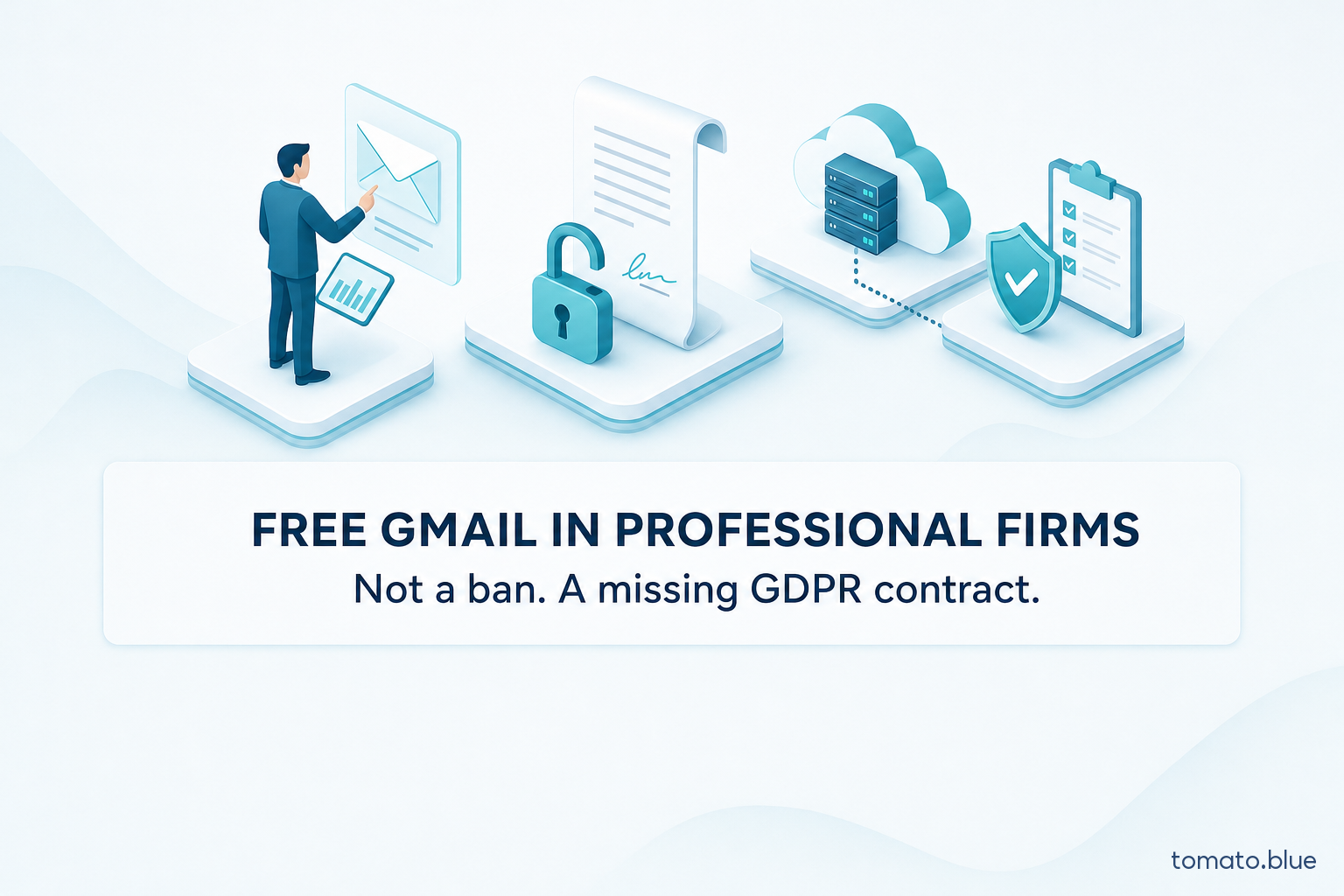
A law firm, an accounting practice or a medical clinic using a free @gmail.com address to exchange documents with clients is not subject to an express ban: no rule prohibits that tool as such. But if that mailbox systematically handles personal data — often belonging to special categories, such as health data, or relating to criminal convictions and offences — the firm almost certainly has a structural problem: no agreement under Article 28 GDPR with the provider that actually processes that content, and the absence of that agreement is already, in itself, a violation of the Regulation. According to Google's own support pages, for the consumer versions of Gmail and Drive the company does not offer a Data Processing Agreement (DPA) and does not act as a processor, but processes the data as an independent controller, on its own terms; for Workspace, that role is covered by the Cloud Data Processing Addendum (CDPA). The difference is not cosmetic: it is the point where GDPR accountability is either documented, or it isn't.
The scenario: a Gmail mailbox handling client data
In small professional firms — few professionals, no dedicated IT — the email account in use is often simply the one already there: a personal Gmail account, or firmname@gmail.com, created in minutes without ever moving to a paid plan. Pleadings, medical reports, tax returns, expert opinions pass through it: documents containing clients' personal data, sometimes special-category data. The issue is not the tool itself — it could be Gmail, Outlook.com, any free consumer mail service — but the fact that it becomes the channel through which processing of third parties' data systematically flows: at that point the provider is no longer a plain technical tool, and it processes data for which the firm is the controller. If it does so on the firm's behalf, it is a processor and the Article 28 GDPR contract is required; if it does so on its own terms and for its own purposes, as with consumer services, it is an independent controller to which the firm discloses client data without being able to issue instructions or demand guarantees.
Article 28 GDPR: what is needed for a provider to process data "on behalf of" the firm
Article 28 GDPR provides that a controller may only use processors offering sufficient guarantees to implement appropriate technical and organisational measures, and that the relationship must be governed by a contract, or other binding legal act, setting out, among other things, the controller's documented instructions, security obligations, the use of sub-processors, assistance to the controller, the return or deletion of data at the end of the relationship, and the controller's audit rights (Article 28(3)).
For the free plans of Gmail and Drive, according to Google's privacy support page, the company does not offer an agreement of this kind and does not qualify as a processor. For Workspace, instead, Google provides the Cloud Data Processing Addendum (CDPA), described on Workspace's compliance page. For a firm using consumer Gmail, this means the agreement Article 28 requires simply does not exist.
Why the risk is higher for regulated professions
The contractual gap does not weigh equally on every controller. Lawyers process data relating to criminal convictions and offences, which Article 10 GDPR and Article 2-octies of Italy's Privacy Code place under a reinforced regime, and more broadly information covered by professional secrecy; accountants process tax, financial and payroll data, often of third parties too (employees, family members, partners); doctors process health data, a special category under Article 9 GDPR, sometimes alongside genetic data. In all these cases, a provider processing that content without an Article 28 agreement leaves the controller without the tool to demonstrate — in an audit or incident — that processing entrusted to a third party was handled correctly, and exposes the firm to a challenge even in the absence of any incident.
Not an automatic ban — and it's worth being precise about it
No rule explicitly bans using a @gmail.com address for work: the GDPR contains no list of permitted and forbidden services. The issue is not using Gmail as such, but the fact that — if Google actually processes the mailbox's content and the Article 28 agreement is missing — the controller is in breach of Article 28(3), and is unable to demonstrate the compliance of the processing, as required by Articles 5(2) and 24 (accountability): compliance must be proven, not merely asserted. The absence of the contract is independently sanctionable, with an administrative fine of up to €10 million or, for undertakings, up to 2% of total worldwide annual turnover, whichever is higher (Article 83(4)(a)), even when no data has been lost or disclosed. A related but separate point: a client's consent to receive emails neither covers nor replaces the contractual and security obligations a controller must have with its own providers — these are different relationships, controller/data subject on one side, controller/processor on the other, and one does not offset the other.
The other provisions that come into play alongside Article 28
Article 28 is not an isolated requirement: it is a symptom of a broader security and accountability framework that, without a contract with the provider, is unlikely to hold up elsewhere: what's needed is compliance with the principle of integrity and confidentiality (Article 5(1)(f)), the ability to demonstrate compliance (Articles 5(2) and 24), data protection built into design from the outset (Article 25, privacy by design and by default), and measures appropriate to the specific risk (Article 32). A provider offering no processing agreement is, almost by definition, one over which the firm has neither visibility nor contractual control.
Moving to Workspace fixes the contract, not everything else
Moving to a Google Workspace plan, with the CDPA, closes the main contractual gap: the firm obtains an agreement governing its relationship with Google as a processor. But that doesn't complete the compliance work: firms still need to manage access and multi-factor authentication (MFA), clear data retention and deletion policies, internal governance over who can access which mailboxes and documents, and checks on any data transfers outside the EU, governed by Chapter V of the GDPR. The same logic — consumer without an agreement, business with one — also applies to Google Drive, when used under a personal account to store client files. And it works the other way around too: with Workspace in place, automatically forwarding mail to a personal Gmail account brings the same data back outside the contractual perimeter just built — we looked at that in forwarding company email to a personal Gmail.
An operational checklist for the firm
- Map where client data flows: mailboxes, cloud storage, accounts used.
- Check whether the provider offers an Article 28 agreement for the plan actually subscribed to (consumer and Workspace are not equivalent).
- If missing, consider migrating to a business plan with an accepted DPA/CDPA.
- Enable multi-factor authentication and define data retention policies.
- Check for any extra-EU data transfers and the relevant safeguards (Chapter V GDPR: the EU-U.S. Data Privacy Framework adequacy decision, currently valid but challenged before the Court of Justice, and standard contractual clauses).
- Document every decision: it's the basis for demonstrating accountability under Article 24, even without incidents.
One last point of professional ethics: the Italian Bar's Code of Conduct (Articles 13 and 28) imposes on lawyers a duty of secrecy and confidentiality over the work performed and the information received from the client, and similar professional secrecy obligations apply to accountants and doctors: duties consistent with the GDPR's approach, but autonomous and additional to it.
In short
Using free Gmail to handle client data is not, as such, subject to an express ban. But if the provider processes that content on the firm's behalf and the Article 28 agreement is missing — as with consumer Gmail, unlike Workspace — the controller is in breach of Article 28 and lacks the tools to demonstrate its own accountability. For regulated professions, with data that is often special-category or relating to criminal convictions and offences, this contractual gap is a concrete and easily fixable risk: migrating to a business plan with a processing agreement is the first step, not the last — access management, retention and data transfers still need addressing.
Do you know which of your providers you have an Article 28 agreement with?
Mapping data flows, checking provider contracts, security measures and documentation: this is the work that turns "we're fine" into accountability you can actually demonstrate. We can do it with you.
Let's talk about your GDPR compliance →