Civil liability and AI: from September 30 the burden of proof changes sides
In a few days, if a customer sues you over damage caused by an AI system, a judge can order you to disclose how it works. If you can't, the court may simply accept the other side's version of events. That's what Legislative Decree no. 160 of 9 September 2026 establishes, in force from September 30.
What changes on September 30
The decree was published in the Official Gazette (General Series no. 214 of 15/09/2026) and enters into force on 30/09/2026 — that date is stated officially in the publication itself, not inferred from ordinary rules. Its title covers both the use of AI by police forces and — the part relevant here — civil and criminal liability for damage caused by AI systems.
It applies to any claim for damages, contractual or non-contractual, caused by the use of an AI system: a chatbot giving a customer wrong information, a tool that scores out a supplier by mistake, an automation that sends a message to the wrong person. The rule targets whoever uses the system, not who built it: it applies even when the AI sits inside software bought for another purpose entirely.
The mechanism: the disclosure order
Anyone claiming to have been harmed can ask the judge to order disclosure of the system's documentation. Full proof isn't required — the claimant only needs to present facts and elements making the claim plausible.
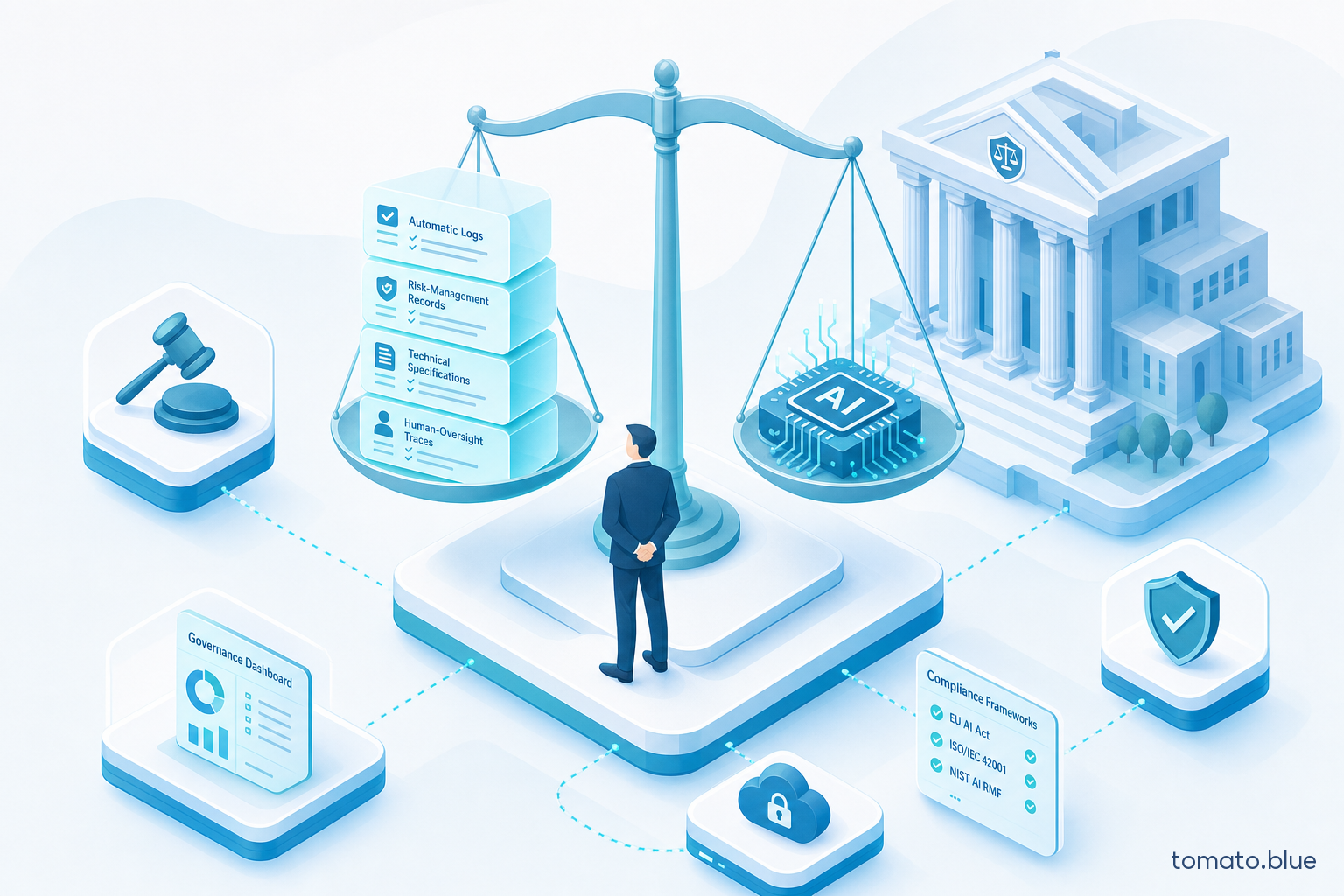
If you fail to disclose without valid reason, the judge can weigh that against you when assessing other evidence. For a closed list of four documents — the registers a system logs automatically, its risk-management documentation, its technical data sheets, and the record of who supervised its decisions — the court can even treat the other party's factual claims as admitted. It isn't a generic "logs" requirement: these four categories, set out in the AI Act, are what actually matters in court. It isn't automatic: it remains the judge's assessment, weighed against other evidence. But it's a real, not theoretical, risk. There's also a fine (€1,500-10,000) for a third party who, without being part of the case, refuses to disclose without justification.
When causation is presumed — and when it isn't
If the damage stems from a breach of an AI Act obligation, the causal link between that breach and the damage is presumed: you have to prove otherwise, not the claimant. It's a rebuttable presumption, not an automatic verdict.
This presumption, though, only covers breaches of AI Act obligations, and the stricter obligations for high-risk systems are expected to slip to 2027 (in line with the simplification package under discussion at EU level) — so today this part of the mechanism only partially applies, while the disclosure order already applies to any claim. One point often assumed wrongly: certified compliance with the AI Act does not, by itself, rule out liability.
Obligations already in force today
Transparency toward people interacting with an AI system, and training for staff who use it, aren't deferred to 2027: they're already in force — but not because of this decree. They come from law 132/2025 (Italy's AI law, articles 3 and 11) and from the AI Act itself, which has required staff AI literacy since 2 February 2025. In practice, that means anyone using a chatbot or a scoring tool should at least know where the system can go wrong and when a human check is required — and the company should be able to show when that training happened, to whom, and what it covered. Worth knowing so you don't wait for a deadline that's already passed.
There's also a direct action against the insurer, modeled on motor-liability insurance: whoever receives a compensation claim has 30 days to state whether a policy exists and with which insurer. Expect insurers to start requiring tighter documentation before covering these risks.
The question to ask by Friday
Put together, the picture is this: until now, anyone harmed by an AI system struggled to prove it, because no one could reconstruct how the system had actually worked. Now that difficulty shifts to whoever uses it. In practice: if a disclosure request landed on your desk tomorrow morning, what would you actually have to show?
- Which AI systems are really in use — including ones embedded in software bought for something else?
- Who activated them, with what data, and who oversees the decisions they produce?
- Is there dated evidence of that oversight, or would it have to be reconstructed from memory?
- Who on staff has received the required training, and what documents prove it?
In most cases, the honest answer is that the file doesn't exist yet. And the worst moment to find that out isn't an internal audit — it's the first hearing, when the judge asks for disclosure and nobody in the company knows where to look.
Key takeaways
- From 30/09/2026 a judge can order disclosure of documentation on an AI system involved in damage, with a low bar (plausibility) to request it.
- Failing to disclose without valid reason can cost you the case: the judge can treat the other side's facts as admitted.
- If the damage stems from an AI Act breach, you must prove there's no causal link — not the other way around.
- Transparency and staff training are already mandatory (law 132/2025 and the AI Act), not deferred to 2027.
- Traceability can't be improvised the day a claim arrives — it has to be built now.
Sources
- Legislative Decree no. 160 of 9 September 2026 — full text on Normattiva (articles 16-20 on civil liability).
- Official Gazette, General Series no. 214 of 15/09/2026 — official publication and entry into force on 30/09/2026.
- Law no. 132 of 23 September 2025 — the basis for the transparency and information duties already in force (articles 3 and 11).
If a claim landed tomorrow, does the file on your AI systems exist?
With TrasformIA we map the AI systems actually in use across your company, including those embedded in software bought for other purposes. We set up rules and controls that generate dated traces from day one, and we train the people who use them, with the documentation needed to prove it. When a claim arrives, the file either exists or it doesn't — it can't be built afterward.
Talk to us →