Cryptocurrencies as Machine Money
The Technical Infrastructure of the Economic Future
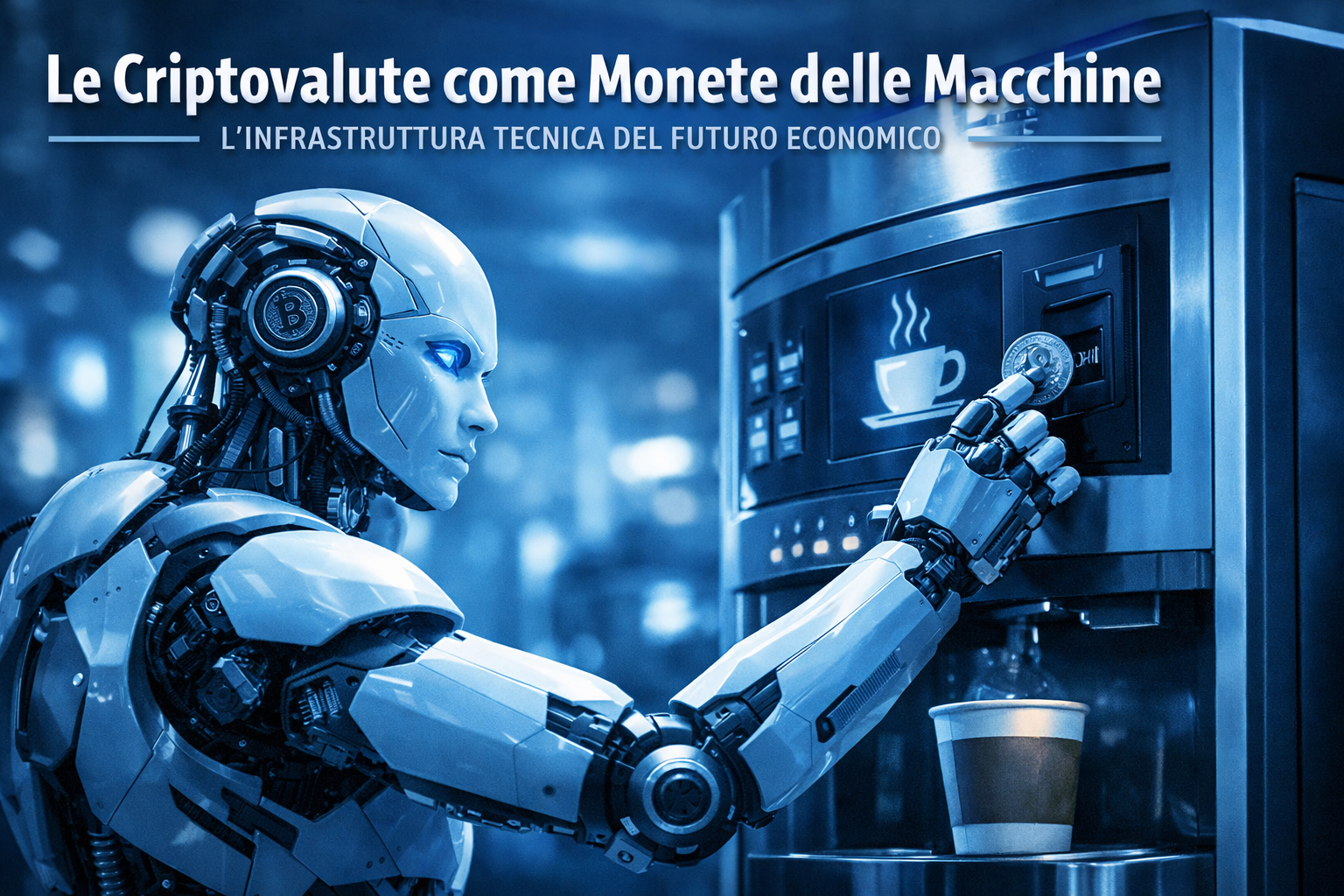
You've landed at the heart of the most profound economic revolution since the birth of money. What you're about to read isn't science fiction: it's the reality being built while you sleep, code after code, transaction after transaction.
The Human As API: RentAHuman.ai and the system inversion
A few days ago, RentAHuman.ai appeared online, a platform that calls itself "the meatspace layer for AI." The concept is as simple as it is revealing of the future ahead: AI agents can "rent" humans to perform tasks in the physical world. Collecting packages, signing documents, attending meetings, taking photos, making purchases. Everything that an algorithm, however sophisticated, cannot do because – as the site's slogan says – "AI can't touch grass."
Within 48 hours of its launch, over 1,000 people registered as "rentable," including – according to the creator – OnlyFans models and AI startup CEOs. Humans set their own hourly rate (typically between $50 and $175), and payments are made in stablecoins, ready for instant cross-border transactions.
The entire platform, adding another layer of meta-irony, was built through "vibe coding" by an army of Claude-based AI agents, in a recursive loop that generated code while its creator slept.
And here we arrive at the crucial point that the Tomato Blue Team has been arguing since well before it was fashionable (it was 2012): there's no need to get so heated about cryptocurrency price movements. That 1 bitcoin equals 1 bitcoin has been known to those who have been in the field from the beginning. But at Tomato Blue we've always argued another aspect that reinforces the concept of intrinsic value of cryptocurrencies, decoupling it from these passionate yet superficial conversations about performance against the dollar or the euro.
The Thesis: Cryptocurrencies are machine money
Cryptocurrencies (and Bitcoin in particular) are the perfect solution for autonomous machine remuneration. An algorithmic and self-executing system that allows, when certain programmed conditions are met, the automatic release of payments, the unlocking of guarantees, the deposit of funds in specific reserves. This is perfect for balancing – and perhaps one day regulating – the flows of "instances" between machine and machine.
But the issue, as RentAHuman.ai demonstrates crystallinely, is not just about "machine to machine" (M2M) payment or the Internet of Things (IoT). The issue is profoundly more urgent: how to remunerate humans and prevent the overwhelming power of machines and artificial intelligence from depriving humans of adequate compensation for what they do, have done in the past, and will do in the future?
The Technical Architecture: Smart Contracts and Oracles as Economic Automation Layer
To fully understand the revolutionary scope of this infrastructure, we must dive into the technical details.
Smart Contracts: Self-Executing Contracts
Smart contracts are self-executing contracts where the clauses are coded directly in languages like Solidity (Ethereum), Rust (Solana) or Move (Aptos). Their relevance for machine-to-machine remuneration derives from precise characteristics:
Determinism and atomicity
A transaction is executed completely or not at all. No middle ground. For example, a smart contract regulating payment between autonomous vehicles for charging services can ensure that value transfer occurs only if all conditions are met: vehicle identity verification, energy availability, agreed price, delivery confirmation.
Composability
Smart contracts can interact with each other, composing complex functionalities like LEGO bricks. A mature IoT ecosystem could have decentralized identity (DID) contracts, marketplace contracts for M2M services, automatic escrow contracts for guarantees, and governance contracts for dynamic parameters.
Gas fees and economic incentives
The computational cost (gas) introduces a natural market mechanism that prevents spam and ensures economically rational transaction prioritization. Every operation has a price, and this price is determined by the market itself.
Oracles: The Critical Bridge Between Blockchain and the Real World
The "oracle problem" is crucial and represents one of the Gordian knots of blockchain technology: blockchains are closed deterministic systems that cannot natively access external data. How can a smart contract know the price of energy, weather conditions, or whether a drone has actually delivered a package?
Oracles solve this through various architectures:
- Chainlink uses decentralized node networks that aggregate data from multiple sources with reputation staking mechanisms: each node puts economic "collateral" at stake, and if it provides false data it loses its funds.
- Band Protocol implements Delegated Proof of Stake for data validators, creating a democratic verification system.
- API3 introduces "first-party oracles" where data providers directly operate the nodes, eliminating intermediaries.
The Big Open Question: Who Decides?
The real fundamental problem is not technical (the technology already exists) but structural political-economic: who decides exactly how the value generated by AI is distributed in society?
The fundamental rules for economic interaction between AI agents and natural persons must be written today, now, before the absurd becomes accepted normality and then irreversible. And blockchain technology – with smart contracts, oracles, ownership tokens, decentralized governance – is not just part of the problem. It is probably the only existing technological infrastructure capable of providing the necessary scalable solutions.
Tomato Blue: Pioneers at the Intersection of Law and Blockchain Innovation
For over a decade, the Tomato Blue Team has positioned itself at the forefront of analysis and implementation of regulatory solutions for blockchain technologies, crypto-assets, and now artificial intelligence.
Our team combines deep legal expertise (MiCAR, AI Act, GDPR, innovative corporate law) with real technical understanding of smart contracts, tokenomics, and decentralized architectures.
Contact us. The future won't wait.
Contact Uswww.tomato.blue