The price of skipping MFA: the CNIL fines a French hospital 500,000 euros
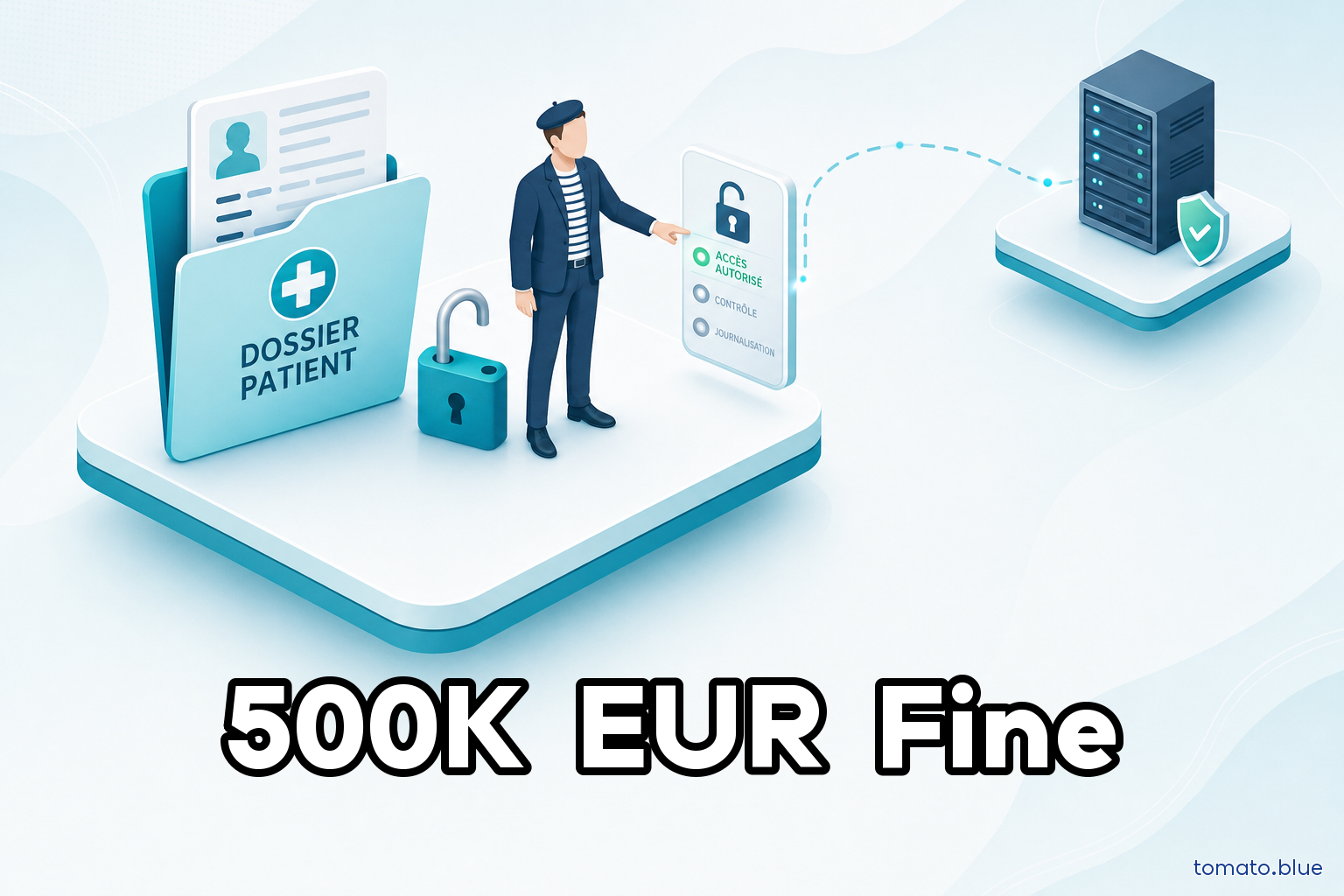
A French private hospital, half a million euros in fines, three technical gaps that any ISO 27001 audit would have flagged months earlier. The CNIL didn't invent anything new — it simply put a price tag on controls that have existed for years and that too many organisations still treat as optional.
On 3 September 2026, the CNIL, France's data protection authority, fined Hôpital Privé de la Loire 500,000 euros. The case, reported by the European Data Protection Board on 9 September, involves unauthorised access to the data of 524,867 patients during the summer of 2025 — not a sophisticated attack, but the exploitation of gaps the decision describes with almost textbook precision.
Three gaps, three missing controls
The CNIL identifies three technical failures at the root of the breach.
Weak authentication. The login procedure required neither a VPN nor multi-factor authentication. In ISO/IEC 27001:2022 terms, this sits squarely within A.8.5 — Secure authentication: a requirement now considered baseline in any environment handling health data, not an advanced security measure.
Unsegmented access control. The system did not implement the "care team" principle: a single user credential granted access to every patient's data in the hospital, not just those actually under that operator's care. This is a missing need-to-know — controls A.5.15 (Access control) and A.5.18 (Access rights)exist precisely to prevent this scenario, and it's typically the most expensive gap to fix retroactively, since it requires redesigning application-level permissions rather than simply adding an authentication factor.
No monitoring. The hospital had no means to detect suspicious activity, either in real time or in the short term. Without A.8.16 — Monitoring activities, an anomalous access to half a million medical records can continue for weeks before anyone notices — which appears to be exactly what happened.
The aggravating factor: after discovery
There's a fourth element in the decision, distinct from the preventive technical controls: the hospital failed to directly notify the 202,246 "trusted third parties" designated by patients — people patients had named as emergency contacts, whose data was compromised along with everything else. This is the crisis-management side of GDPR Article 34, not its prevention: even once the damage is done, transparency toward data subjects remains a separate, independently sanctionable obligation.
Why this case is a business case, not a headline
The useful part of this story isn't "another hospital got breached" — it's that the regulator did, for free, the work a gap analysis audit normally does: it took three standard controls, verified their absence, and put a euro figure on the cost of not implementing them. For anyone handling sensitive data — healthcare, but also public administration, professional firms, financial services — the question is no longer theoretical:
- Do our external access points require MFA, with no exceptions?
- Do application permissions follow genuine need-to-know, or does a single admin credential open more than it should?
- If someone accessed a thousand records anomalously within an hour, would we notice before a newspaper or a regulator did?
If even one of these answers is "we're not sure," the gap already exists — the CNIL just showed how much it can cost to leave it open.
Sources
Would your access control survive an audit like this one?
We run ISO 27001 gap analyses and GDPR compliance reviews on authentication, access control and monitoring, for organisations handling sensitive data that can't afford to discover the gaps after an incident.
Talk to us →